Monday, July 14, 2014

The Children of Old Leech Excerpt: “Snake Wine” by Jeffrey Thomas


Today’s excerpt from The Children of Old Leech leaves the familiar–and frightening–confines of the Pacific Northwest for a locale on the other side of the world: Vietnam. Let’s crack open a bottle of “Snake Wine” with author Jeffrey Thomas.


In his flat on the third floor of the narrow building he had bought with all his savings, ill-gotten and otherwise, Hong pulled a bottle out of the plastic shopping bag she had fetched from her Honda’s seat compartment. “My father likes to drink this sometimes,” she told Gorch. Smiling with charming if unconvincing coyness, she further explained, “It’s good for a man’s baby.”

“Baby?”

“You know,” she said. She pointed toward his crotch and giggled.

“Ah, I see. Makes baby grow up big and strong, yeah?”

“Yesss.”

“Let’s have a look.” He held out his hand. “I’ve seen these things a million times here but I’ve never really wanted to try it before.”

“Oh, but you will drink this one, won’t you? Because it is from me?” She passed him the bottle.

“For you, and for my baby, I’ll do it.”

It was a bottle of ruou, or rice wine, and he had drunk that on its own. But this type of ruou, which he’d seen sold at gift shops such as those at the Cu Chi Tunnels and the Saigon National Museum, had conspicuous extras stuffed into the bottle. Usually it was a cobra, preserved in the yellowish wine as if pickled in formaldehyde, maybe with a huge black scorpion or a fistful of smaller snakes and some herbs added for good measure. Hong’s gift did have some blanched-looking herbs at the bottom, but no scorpion, and the snake coiled inside wasn’t a cobra, unless its hood was closed.

Gorch turned the bottle around slowly to see it from all angles, and held it up in front of the fluorescent ceiling light. His brows tightened. Definitely not a cobra. And maybe it was a result of the animal’s saturated tissues being distorted, but he almost questioned whether it was even a snake. He was reminded of the animal called a worm lizard, an amphisbaenian, which possessed a long pinkish body that looked segmented like an earthworm, with only a rudimentary pair of forelegs. It almost seemed this creature had such forelimbs, if withered, unless those were just bits of sloughing skin. Its eyes were bleached dull gray. It was looped in on itself within the glass, coiled around and around in a spiral as if chasing itself unto infinity.

“A dragon fetus, perhaps? Ace.” He handed her back the bottle to open. He took down a shot glass. “Are you going to drink it with me?”

“It’s a drink for men,” she told him. “I don’t have a baby.” Her smile was a mixture of carnality and passable innocence that made his stomach squirm with hunger, as if he had his own dragon fetus coiled inside him.

She filled his shot glass, and he took a tentative sip. He tried not to show his disgust lest he insult her. After all, her father had unknowingly sacrificed this elixir for his benefit. It tasted just as he had expected: crude rice wine mixed with the essence of a reptile terrarium.

“Do you like it?”

Gorch didn’t think he’d be stocking this beverage in his pub anytime soon, but he said, “A fine vintage. Cheers.” He took another sip.


The Children of Old Leech: A Tribute to the Carnivorous Cosmos of Laird Barron may be ordered directly from Word Horde or wherever better books are sold. Ask for The Children of Old Leech and other Word Horde titles at your favorite bookseller.

Friday, July 11, 2014

The Children of Old Leech Excerpt: “Good Lord, Show Me the Way” by Molly Tanzer


...we love you...


We close this week of excerpts from The Children of Old Leech with Molly Tanzer's epistolary tale of academic horrors, "Good Lord, Show Me the Way."

  ---

 Gasoline Fire Burns Olalla Man; Destroys Home 
By Jim Warren 

April 27th, 1992 -- Early Tuesday morning, Burton Wulla Fines was admitted to Tacoma General Hospital with severe burns covering the left side of his face and body, and a mangled left hand, also burned. 

Sally Wallings, a neighbor, called 911 at 1:18 AM when she spotted flames reaching above the trees between their properties, alerting local authorities to "a powerful inferno" on the premises. When firefighters arrived they found Mr. Fines' home ablaze, along with several adjacent trees. Fines himself was discovered wandering around one particularly large spruce, throwing gasoline on it from a can from time to time, and "ranting" according to volunteer firefighter Glenn Woodworth. 

"We tried to get him away from the tree," said Woodworth, "but he wouldn't come along. He kept shaking his fist at it and accusing it of being 'infested' and that he 'wouldn't submit' to the will of its 'agents.' He claimed it had 'whispered to him for the last time,' that he would burn out the Great Satan within, and be done with the business." 

"Brent had always hated that tree," confirmed Wallings. 

Woodworth and the rest of the firefighters entrusted Fines to the paramedics who had arrived on the scene in order to fight the fire consuming his house. Soon after, all present reported hearing an "explosion" and returned to find Fines scorched along the face, body, and hand. With the help of the paramedics, Fines' clothes were extinguished and he was taken to Tacoma General. Sadly, this blast resulted in the burning to the ground of Fines' home. 

When asked why the paramedics had not removed Fines from the site of the burning tree, they replied he became "belligerent and abusive" when they tried. At the time he tossed the can of gasoline onto the tree, causing the explosion that burned him, the paramedics had been discussing methods of restraining or sedating him. 

"He accused us of conspiring with 'vassals of The Great Satan,' whatever that is; that we were there to 'bind him' or something like that. He was pretty incoherent by then," reported Jim Baker, an EMT. Fines remains in critical condition at Tacoma General. 

 ---

 The Children of Old Leech: A Tribute to the Carnivorous Cosmos of Laird Barron may be ordered directly from Word Horde or wherever better books are sold. Ask for The Children of Old Leech and other Word Horde titles at your favorite bookseller.

Wednesday, July 9, 2014

The Children of Old Leech Excerpt: “Learn to Kill” by Michael Cisco


Today’s excerpt from The Children of Old Leech comes from Michael Cisco‘s patricidal tale, “Learn to Kill.”


Nodded off! How long was that? Everything looks the same. My boots, bony knees, knuckly hands. My chair. The window. Bare boards.

Lessons from Dad. When I was about eight or nine, I decided, I forget why, to provoke my father. I was very contrary and then, I remember standing stock still shouting

“FUCK YOU! FUCK YOU!”

at him. He smiled at me, queerly. Then he went and shut himself up in his room. That was his sanctum. He padlocked it when he wasn’t in it. I wracked my brains for a way to get in, and I never did. With all my ingenuity, my genius for trouble, my intuitive sense of escape routes and infiltrations, when there was no hillside full of dense foliage I couldn’t wriggle inside somehow, to think, I never managed it. I never saw the inside of it, even after I killed him.


The Children of Old Leech: A Tribute to the Carnivorous Cosmos of Laird Barron may be ordered directly from Word Horde or wherever better books are sold. Ask for The Children of Old Leech and other Word Horde titles at your favorite bookseller.

Monday, July 7, 2014

The Children of Old Leech Excerpt: “Walpurgisnacht,” by Orrin Grey


Our third excerpt from The Children of Old Leech comes from “Walpurgisnacht,” by Orrin Grey. Traditionally, April 30th marks the feast of Saint Walpurga, an 8th Century German Abbess. But it’s also held to be the night that witches meet and revel on the Brocken, the highest peak in Germany’s Harz Mountains…


On the train, Nicky told me about the Brocken Spectre. “It’s a sort of optical illusion,” he said, leaning forward, his elbows on his knees. Nicky was younger than me, and prettier, and his dark hair fell in front of his face whenever he slouched, which was often. “The sun casts a giant shadow of you on the clouds below, right, and your head gets this prismatic halo. Like an angel.”

“I hear the sun only shines here like sixty days a year,” I said. “Besides, it’s night.” I was only half-listening anyway, my head lolling against the cool glass of the window. I’d had more than a few drinks at the airport bar, and I could feel a headache trying to force its way out past my eyes. Outside, I could see our destination looming up out of the darkness, the two towers of the Sender Brocken, old and new. Like Tolkien’s Minas Morgul and Orthanc. The sun was still going down, and the towers stood out like shadows against the gloaming, their lights already on. Gleaming yellow ones in the windows of the old tower, now the Brocken Hotel, and blinking red ones to warn planes away from the new tower, a candy-cane-striped lance that jutted skyward from the peak.

“It doesn’t look terribly inviting,” Nicky said, noticing my inattentiveness and nodding at the towers.

Now to the Brocken the witches ride.” I intoned, and then, without bothering to glance and see his puzzled expression, explained, “It’s Goethe. From Faust.”

That was why we were going, of course. It was Walpurgisnacht, the night when the witches and devils gathered on the crown of the bald mountain to welcome the spring. Nicky and I, and whoever else was on the train with us, were the witches in this equation, and we were all gathering on the Brocken to kiss the ass of a black goat.


The Children of Old Leech: A Tribute to the Carnivorous Cosmos of Laird Barron may be ordered directly from Word Horde or wherever better books are sold. Ask for The Children of Old Leech and other Word Horde titles at your favorite bookseller.

Friday, July 4, 2014

The Children of Old Leech Excerpt: “Pale Apostle,” by J. T. Glover and Jesse Bullington


 Photo Courtesy of Nick Gucker.

Today’s excerpt from The Children of Old Leech comes from J. T. Glover and Jesse Bullington's collaborative tale, “Pale Apostle,” which I’m sure you’ll agree sets up the fireworks with a dangerously short fuse…


The bell at the front of the shop tinkled, and Wah clicked her teeth—she hadn’t heard his key in the lock, which meant he’d left the door open again. It was bad enough he insisted on making deliveries to all the family associations himself, but his forgetting to lock up was simply unsafe. Ducking through the curtain, her slippers whisking against the boards, she saw his familiar silhouette across the dark shop. He’d turned and was locking the door.

“It doesn’t do much good, now,” she said, trying to keep the chiding tone from her voice. “When I’m in the back, though, try to remember to—oh!”

The white man smiling at her across the shadowed bins and shelves was not her father.

“I sorry, honorable sir, but we closed right now,” she said, speaking with deliberate fresh-off-the-boat awkwardness even as her mind raced.

Her father was probably talking over old times at some association by now, and might not return for hours. It wasn’t late enough yet for the police to be rattling doorknobs, and they rarely took much notice of crime in the Chinatown anyway. Who would hear if she screamed? Mr. Dong next door, perhaps, but perhaps not…

Top shelf, middle aisle. As she stepped around the counter, she studiously kept her eyes on the intruder, instead of the modest display of cutlery. If she could just—

“How excellent,” the stranger said, speaking in perfectly unaccented Szechuanese as he glided toward her, past the knives. “That means we shall not be disturbed.”

The smile he gave her stretched his strangely ageless face into a rictus—like most white men, his exotic features somehow coalesced into a bland, nondescript whole. His black coat and broad-brimmed hat were wet with the night’s rain, leaving puddles on the floor, but his skin looked parched as scrolls from a temple. He reached inside his coat, and Wah flinched, wondering if it would be a weapon, or worse, handcuffs—given the choice between a stickup man or a plainclothes Seattle policeman, she would take the lesser villain. Instead, he held out an envelope to her, as dry as the withered hand that held it.

“My name is Clarence Kernochan, and I have a business proposition to discuss with you.”

“My father—” Wah began, but he cut her off in the rude fashion of Americans, waggling the envelope.

“I trust you will surely find this to the advantage of both yourself and your father, Miss Sung.”

Wah looked back at his face, and in the instant before she saw him straight-on, she could have sworn that his black pupils seemed to undulate, as if something wriggled behind them.


The Children of Old Leech: A Tribute to the Carnivorous Cosmos of Laird Barron may be ordered directly from Word Horde or wherever better books are sold. Ask for The Children of Old Leech and other Word Horde titles at your favorite bookseller.


Links: Hardcover (Barnes and Noble, Amazon), Nook, Kindle.

Wednesday, July 2, 2014

Children of Old Leech Excerpt: "The Harrow" by Gemma Files


The Children of Old Leech Deluxe pre-order spotted in the wild. Courtesy of Anya Martin.


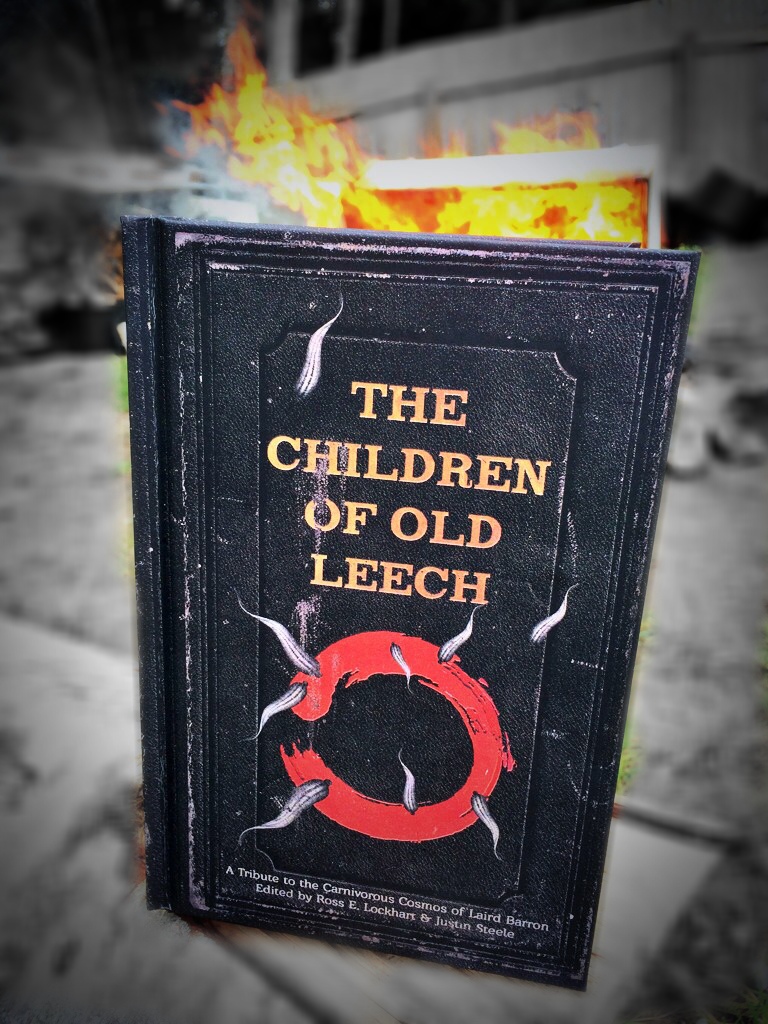
As you might have heard, we’ve got a new anthology landing July 15, The Children of Old Leech: A Tribute to the Carnivorous Cosmos of Laird Barron. Over the next few weeks, we thought we’d share a brief excerpt to preview each story. These will be dropping on Mondays, Wednesdays, and Fridays, and start today with “The Harrow,” by Gemma Files


The earth is old and full of holes, Lydie Massenet’s mother used to say, at least once a day, back when she was still Lydie Pell. Its crust is thin, and underneath there’s nothing but darkness. A rind, that’s all we live on; just thin ice, waiting for it to thaw and crack. No need to dig, really—if they want to find you, they will. Never trust anything that comes out of a hole.

And: Okay, Mom, Lydie would say, the way her father had taught her to. That’s good. That’s fine. Then just smile and nod, all the time staring off at nothing much, something invisible—contemplating Mars, he called it—until her mother finally stopped talking.

You have to know this, Lydie, if nothing else, her mother told her. Darkness shifts, darkness conceals; it’s impossible to know what’s hiding inside it, no matter how hard you try. But if history teaches anything, it’s that what we don’t understand, we fear… and what we fear, eventually, we come to worship, if only to keep it in its rightful place. To make sure it doesn’t come after us.

Yes, Mom. Okay. Sure.

’Til, one day: Stop saying that, goddamnit! her mother yelled, and slapped Lydie across the face, so hard her glasses cracked in half. That was the day her father brought Doctor Russ home, the day before her mother went somewhere else—first for a rest, and then, after everything they did to her while she was there had utterly failed to make her well enough to come home again, to stay.

What’s wrong with her, Daddy? Lydie asked her father, at last, to which he only shook his head and sniffed, trying to pretend he hadn’t been crying.

Honey, I wish to God I knew, was all he said, in return. And hugged her a little too long, a little too tight.

Friday, June 20, 2014

Interview: Scott Nicolay


One of the standout story collections of the year so far is Scott Nicolay's Ana Kai Tangata (the deluxe version contains an extra chapbook), which I reviewed here. Here's a recent interview I conducted with this breakout author.


When did you first discover weird fiction, and what is your own personal definition of what is considered weird fiction?

One of my very earliest memories is standing next to my mother in the kitchen and telling her about my imaginary monster friends...at least I think now they were imaginary. I was obsessed with monsters and weirdness and all things macabre as far back as I can remember. Perhaps from before birth. I was an early reader as well, so relatives sometimes brought me advanced books one would not normally give a child. Kind of like giving a piece of fruit to a trained monkey, I suppose. When I was seven years old, my Uncle Ed came down from Massachusetts and left me a copy of Frankenstein and a Scholastic books collection called 11 Great Horror Stories, one in a series edited by Betty M. Owen. “The Dunwich Horror” was the anchor tale in that volume. I was drawn to the story by the cover blurb “Wilbur Whateley’s diary was not the ravings of a madman. The Dunwich Horror--huge, ravening, and invisible--was REAL!” It did not disappoint. I still return to “The Dunwich Horror” year after year. Though some dismiss it is derivative and inferior, I find it to be one of Lovecraft’s most technically accomplished works, and above all, a masterpiece of atmosphere and dread. Lovecraft became the first writer whose works I sought out by name. Coincidentally, my Uncle Ed lived in the same area of Massachusetts where Lovecraft’s fictional Dunwich was set.

A few years later I finally found more of Lovecraft, as well as other writers of the Weird such as Hodgson, Blackwood, Clark Ashton Smith, and John D. Keefauver. The ‘90s brought me Aickman, Klein, Ligotti, Lamsley, and Jean Ray, as well as S.T. Joshi’s essential critical study, The Weird Tale. During the ‘80s and ‘90s I also read very deeply in Noir, and I came to understand Noir and the Weird as two aspects of the same thing. Jim Thompson hit on this commonality when he said, “There are thirty-two ways to write a story, and I've used every one, but there is only one plot–-things are not as they seem.” In Noir, that revelation occurs at the social and/or political level, whereas in the Weird, the revelation is about our place in the universe...or lack thereof. I wrote a few stories in the ‘90s, though fortunately none of them were published and none of them survive.

A few years ago, as I was beginning the stories that now make up my book, I wrote down some guidelines for myself that I could use to refine my approach to the Weird. I used the “Dogme ’95” film manifesto as my model, and I originally posted my “Dogme 2011” on Facebook for a few friends to see. Later, Ann and Jeff VanderMeer asked to print it at the Weird Fiction Review Online, where it generated a little controversy, something I am apparently becoming good at. Some readers took it as a set of prescriptive rules, and there were a certain amount of “rules are bad” gut reactions. But really, I never meant it for anyone other than myself. All the stories in Ana Kai Tangata are “Dogme 2011” stories though, and I feel this gives the collection a certain thematic and esthetic coherence. Interestingly enough, Jeff VanderMeer’s novel Annihilation works perfectly as a “Dogme 2011” novel, not that I imagine I had any influence on his work. It’s more a case of two trains on the same track, with his far ahead of mine.


Much of your own fiction tends to be novella-length. What attracts you to this story length? Do you ever see yourself going even longer by writing a novel?

I let the stories grow the way they need to, following the principle framed by Charles Olson and Robert Creeley that “Form is never more than an extension of content.” Olson’s essay “Projective Verse” and his method of “Composition by Field” are well known to poets, but I have found his ideas applicable to prose fiction as well. While I was writing the stories in Ana Kai Tangata, I began consciously allowing atmosphere and characterization to drive my narrative, rather than plot. I feel that plot is the most artificial element of narrative--it’s this illusion of structure we impose on the artificial worlds we writers create. Which is not to say my stories don’t have plots--they do--but I let those plots grow together with the other elements. In this way, I hope that my stories present a more realistic and immersive world within which the reader can encounter elements of the Outer and Other.

As for tackling a novel, I have no immediate plans. Obviously, novels are more lucrative for a writer to pursue than stories. By some definitions “Tuckahoe”--at over 42,000 words--is a short novel. I could’ve stretched it further, developed certain aspects and tried to make it a stand-alone novel or even a screenplay, but I did not have a sense that the story itself wanted to go there. I feel it is complete as it is, and though I write long, I do not pad. Everything in my stories has a purpose, whether or not it is apparent to every reader. The majority of readers and reviewers have picked up on that, so I feel I was successful in that regard.

I do have several ideas that might support a narrative of novel length, but I am not developing any of them at the moment. Not all are Weird fiction, by the way, at least not in the sense of Weird/Cosmic Horror. The main one is a YA novel which is already over 30,000 words long. I expect anything I write will be “weird” in some way, big “A” or small “a.”

At present I am working on at least five stories of varying lengths, several of which are for invites and/or commissions...and of course, I have that large ongoing translation project.

Having said all that, I am very interested in the novel, and the possibilities it represents for Weird Fiction. I think there are only a handful of truly successful “Weird” novels. Fritz Leiber’s Our Lady of Darkness. Shirley Jackson’s The Haunting of Hill House. William Hope Hodgson’s novels, especially The House on the Borderland. Medusa by E.H. Visiak. Caitlin R. Kiernan’s The Red Tree. And most recently, Annihilation by Jeff VanderMeer. We have enough successful models now of how the Weird can succeed in the novel form that a critical mass may be imminent. Perhaps the Weird is finally about to complete the full transition to the novel--and from there to the screen--that its cousin Noir made generations ago.


Your first collection Ana Kai Tangata has stories that share certain themes. For example, a few stories feature caves, and some end with the protagonist about to be "devoured" or something similar. How do your own personal fears, experiences, and thoughts bleed into your fiction?

Obviously, I am not claustrophobic. Caves make me happy, though of course the cave environment must be treated with respect. I have no special fear of heights either, but I am a little more skittish about rope work after a 2004 accident in which I was dropped over twenty feet during vertical caving practice and broke my back. Now I’m Titanium Man. Unfortunately, personal circumstances and the closure of nearby caves due to White Nose Syndrome, a fungal infection that has decimated hibernating bat populations in the Northeast and continues to spread across the country, have made it difficult for me to continue caving. I haven’t had any serious underground time since 2009, when I served as the field archaeologist on a cave expedition to Rapa Nui.

Though I definitely draw on my own experiences in my tales--“If you don’t live it, it won’t come out your horn,” as Charlie Parker said--that doesn’t mean my protagonists are versions of me. They may go some of the places I’ve been, may share some of my experiences, but none of them are meant to represent me. That said, large portions of several of my stories describe events that actually occurred.


Your story "The Bad Outer Space" features a child narrator that comes across as genuine, which is no easy feat to pull off. What challenges did you face while writing through such a narrator?

That story came as naturally as any of the others, if just as slowly. I credit Kelly Link’s “The Specialist’s Hat” as my initial inspiration for choosing that approach, although I consider her story one of the finest Weird tales ever told, and I hesitate even to invoke its name in relation to my own work.

I don’t feel that I faced any special challenges in writing that story, and in fact many key elements simply came to me when the time was right. I was lucky to have a major author as first reader on that one, and he helped me tighten up the language. I might have been trying a little too hard to get the narrator’s voice in earlier drafts, but with a little help from a friend, I relaxed it and let it become more natural.


What do you believe to be the best weird fiction out there? What authors, novels, anthologies, and stories should readers familiarize themselves with?

As I’ve said before in various forums, I believe we are in the midst of a Weird Fiction Renaissance, and that The Weird is finally coming into its own as a legitimate literary genre or form. This is the golden age of Weird Horror, this here, this now. So many people point to True Detective, but True Detective was faux Weird, and I think the ongoing success of Jeff VanderMeer’s Southern Reach trilogy is far more important, and points to the readiness of the general readership to embrace the well-written Weird.

This is really a loaded question, as my answer will inevitably leave out a host of brilliant authors. Among contemporary writers of the Weird, Campbell, Kiernan, VanderMeer, Ligotti, Cisco, and Barron have all achieved mastery. Lansdale is also a master, and our finest living storyteller, though the Weird is only one of his many modes. He “gets” the Weird though. Lamsley and Klein if they were still writing, but they are not. Hot on their heels are such writers as Livia Llewellyn, Richard Gavin, John Langan, Matt Cardin, Simon Strantzas, Allyson Bird, Joseph S. Pulver Sr., Stephen Graham Jones, Gemma Files, Kaaron Warren, and Paul Tremblay, all of whom work in the Weird to varying degrees. The late Joel Lane. Nathan Ballingrud’s first collection North American Lake Monsters last year was a masterful debut that blended the Weird with other approaches to horror. I am honored to be part of this year’s class, which includes such huge talents as Daniel Mills, John Claude Smith, Damien Angelica Walters, and Simon Strantzas, all writers I admire. Strantzas is the giant among us of course. There are many others, but those are the writers I have read most closely.

In the future, I recommend readers keep an eye on Jayaprakash Satyamurthy, Suresh Subramanian, Michael Griffin, Anya Martin, and Selena Chambers, as well as some exciting authors who blend the Weird and Bizarro, such as Nikki Guerlain, Josh Myers, and Jordan Krall. Bizarro is a very exciting genre altogether, and I expect to see more cross-pollination with the Weird. Nicole Cushing, for example, is a major Weird fiction author who began in Bizarro.


2014 has been a good year for you, Ana Kai Tangata was published and garnered some excellent reviews. Do you have any other fiction slated to be published this year? What else can you tell readers about your plans for the future?

So far, so good. I am grateful beyond words that so many readers appear to have understood my work just as I intended--I honestly never expected that. As a poet, you are taught to be happy if anyone gets anything at all... And I am especially grateful to those who have written complimentary reviews of the book, most of them people I knew little if at all beforehand.

As for new work, I have a story in Word Horde’s Laird Barron tribute antho The Children of Old Leech. Since you co-edited that with Ross Lockhart I presume you are fishing for a plug, so here it is. The story is called “Tenebrionidae” and I cowrote it with my son Jesse James Douthit-Nicolay, based on his experiences riding freight trains across the south. I’m proud of what Jesse and I accomplished with that one.

I also have a piece in The Starry Wisdom Library Catalog, which is due out sometime soon, and there is one older story that is still kicking around. Beyond those, I am working on several stories, mostly for commissions or invites. It’s too early to comment on any of those, however, and they probably won’t appear until 2015. Each new story is a struggle, but writing them causes less pain than not writing them.