Showing posts with label Ellen datlow. Show all posts
Sunday, August 24, 2014
Review Roundup: August
I'm finishing up the summer by posting another roundup of reviews. This time I review a collection, an anthology, and a book of non-fiction.
--
Gateways to Abomination by Matthew M. Bartlett
I tend to avoid most self-published works, as the vast majority I have encountered tend to be self-published because no publisher in their right mind would even touch them. This book is one of the exceptions, and I wouldn't be surprised to see it re-released under a publisher's banner. Billing it as "collected short fiction" kind of sells the book short. This book is MUCH more than that. It reads like a post-modern novel. Very short stories and vignettes combine in an effective way to offer glimpses into an area infected by a sort of weird evil, using a phantom radio station to twist reality. Bartlett's book gets under the skin and digs deep. There is a mad genius at work here, the stories offering enough of a glimpse that a full picture nearly forms, yet not giving away the full game. This collection of nightmares, and disturbing radio broadcasts blends together so well that the book transcends the concept of a simple short fiction collection and becomes so much more. Sure, the book could use a tad bit of polish, no different from many small press books, but the quality of writing here hints at a promising future. I fully anticipate this book to be considered by many to be a modern cult classic, and I very much look forward to more from Mr. Bartlett. Highly recommended, there is something special at work here.
Fearful Symmetries edited by Ellen Datlow
Ellen Datlow is the modern queen of dark fiction. It simply cannot be disputed. Published by Canadian publisher ChiZine Publications (who already put out one stellar horror anthology earlier this year with Shadows & Tall Trees 2014 edited by Michael Kelly) Fearful Symmetries is a non-themed horror anthology consisting of twenty short stories by many of the genre's best. As with most Datlow anthologies, these stories run the gamut from pure horror to dark fantasy, and as such there is a bit of something here for all sorts of readers. In reading this anthology I found that most of my favorite stories came not from my usual favorite authors, but from authors of whom I was less familiar with: Helen Marshall, Robert Shearman, Siobhan Carroll, Carole Johnston, Catherine Macleod, Bruce McAllister and Pat Cadigan. Definitely one of the better anthologies of the year.
When the Stars Are Right by Scott R. Jones
Scott R. Jones has done something really special with this book. What sounds like a ridiculous premise, namely taking Lovecraft's fiction and using it as the basis of a spiritual path, actually comes together to create a fun reading experience. Taking a unique look at Lovecraft's deities (the reader of this may never view them quite the same again) and using his own personal experiences, Mr. Jones makes a case for living a life dedicated towards achieving the 'Black Gnosis,' a sort of tentacled Nirvana. The "R'lyehian" therefore lives a life constantly seeking knowledge and experience, in both dreams and waking life. It's clear that the author knows his Lovecraft in a way that perhaps no one else does. At times hilarious, at others deeply personal, this book is as much a love letter to the Gentleman of Providence as it is anything else, a cosmic thank-you note if you will. Some readers might not think this book sounds like their cup of tea, but anyone with an interest in Lovecraft should put this on their to-read list immediately. It's highly entertaining, and there's enough interesting concepts inside that all Lovecraft fans will find something to take away from it. Highly recommended.
Monday, August 11, 2014
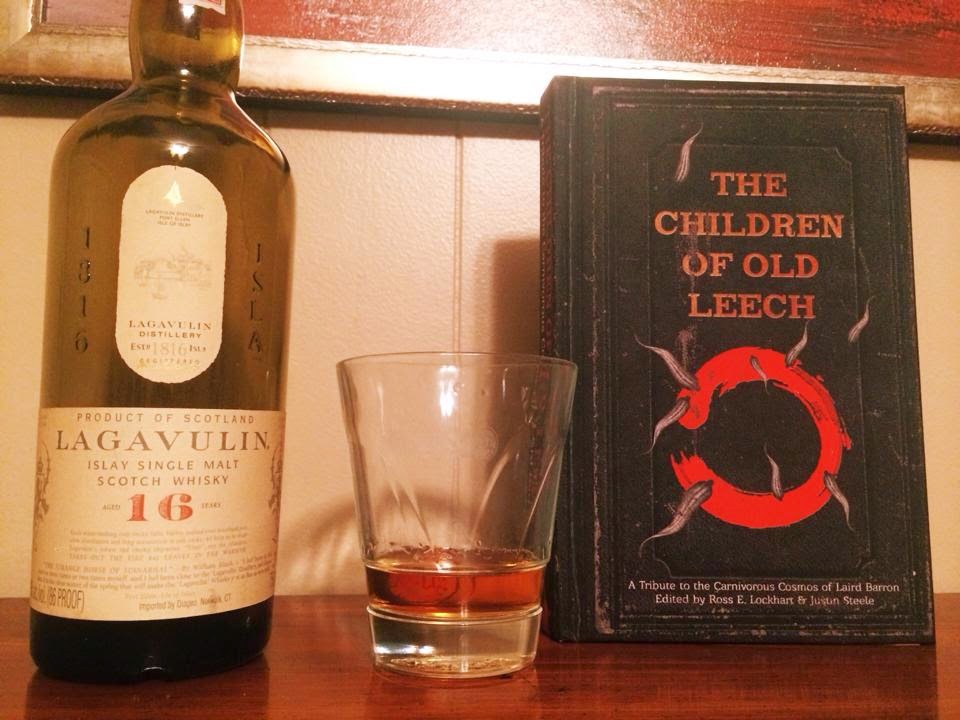
The Children of Old Leech Introduction: Of Whisky and Doppelgängers by Justin Steele
We told you there would be more this week. What follows is my introduction to The Children of Old Leech, “Of Whisky and Doppelgängers.” And stay tuned for more!
—
If you value your health, sanity, and general sense of well-being, then you should stop reading this book right now. Close the cover, put it back on the shelf, and head on over to the non-fiction section. Pick up a book on fishing, or pottery, something safe. Anything but this book.
If you’re still reading you must be damaged goods, nothing to lose. Maybe you saw that I started with a warning and felt the need to prove me wrong, to prove that you like to live life on the edge, laugh in the face of danger, shit like that. Maybe the warning tugged at your curiosity, intrigued you enough to carry on. Just remember what happened to the cat.
I’m supposed to be writing an introduction. That’s what Ross wanted me to do anyway, but I owe some responsibility to my fellow man, and what we did with this here book, what we unleashed, well, it’s just wrong. I’m sitting here at my desk, a near empty glass of Lagavulin on the desk edge, the bottle in easy reach. Three feet from me, propped in the corner of the room, is a 12-gauge pump-loaded with double-aught buckshot. If that’s not enough I have two .45s and a recently sharpened hunting knife within reach, so no matter how it goes down, it won’t go down easy. But who am I kidding. THEY want me to write this. It’s part of the project. Until my part’s done I’m safe. At least I think so.
I should probably start from the beginning. Tell you how I first discovered this Lovecraft guy, and how reading his fiction kicked me off onto this whole “weird fiction” thing, but I’m sure you’ve heard that one time and time again so I’ll skip ahead a little bit. A few Cthulhu Mythos anthologies into my tentacle binge, I picked up Ellen Datlow’s Lovecraft Unbound, and was pleased to see an anthology striving to avoid falling into pastiche territory. It was during my late night readings that I discovered my first Laird Barron tale. “Catch Hell” did something to me that only a few special stories managed to do: upon finishing I reflected on the story for a minute or two, and then turned back to the first page and immediately reread it. After the second read I walked over to my computer and ordered The Imago Sequence and pre-ordered Occultation. There was no question that I had stumbled upon something special, something dangerous. Who was this Laird Barron guy? He looked like a pirate, or a grizzled Viking warrior. His writing was a blend of genres that I loved. One part pulp, one part noir, two parts pure cosmic terror, blended smooth and seasoned with a literary skill that few possessed. I had found weird fiction for the connoisseur. If I had only known what I was getting into.
Flash forward a few years later, and I’m sitting here in my dimly lit office space, gulping scotch and wondering how I ever let myself get drawn into this mess. The light from my lamp is reflecting off my tin poster of The Good, the Bad, and the Ugly. I let Clint Eastwood’s stoic squint and Lee Van Cleef’s predatory glare serve as reminders that I have to be tough, finish this up. The wind is whipping at the window and I find myself eyeing the 12-gauge once every few seconds.
In September or so I had a conversation with Ross Lockhart, the other man responsible for what we’ve done here. We were both huge fans of Laird’s fiction, recognized its power. By the end of our talk, the wheels were in motion. We were so excited, completely oblivious as to what the actual significance of the anthology would be.
Finding the authors to take part actually proved to be the easy part. Laird’s work is highly respected, and offers authors much to work with. Ross and I wanted to find some of the best writers of weird fiction and offer them a chance to play in Laird’s playground. They could use the more literal elements of Laird’s growing “Pacific Northwest Mythos” or utilize his themes. Pastiche was not welcome. We wanted the authors to use their own unique talents and voices in order to do Laird justice, yet not by simple mimicry.
The thing is, Laird’s fiction is powerful, and not just in the literary sense. Some theorize that there exists some fiction that has the ability to bleed into reality. The words serve a higher function, act as a sort of formula. When these words are read they open a gate to somewhere else, allow them to come over. What Ross and I have done is complete the formula, see? Laird’s works were the base, the true source of the power. With these stories we amplified it, radio towers strengthening the signal.
Ross experienced it first. He’d be out walking his dog in sunny California, or out at his local bookstore when he would see him. Only it wasn’t actually him? Ross would catch a glimpse, just enough for him to realize he’d seen Laird. When he looked back he would see Laird standing there, at the mouth of an alley, or the end of a row of bookshelves. And it was definitely Laird, his mug isn’t the kind you mistake for someone else. Ross was perplexed, he told me later, because he was sure he was seeing Laird. He looked long enough for the imposter’s face to split into a black grin, and then with a wink the not-Laird would duck into the alley or step away from the aisle of books. Ross thought Laird must have been playing some kind of elaborate prank on him, until I pointed him to one of Laird’s blog posts. Apparently some of Laird’s friends have seen this doppelgänger before, but never more than once. I know this spooked Ross, and he hasn’t been the same since. I often ask him if it’s happened again, but whenever I bring it up he goes pale, changes the subject. If I push, he firmly denies anymore sightings, but I have my doubts.
I figured it out. Ross thinks we are just putting together a good group of stories, tries to justify his weird sightings with lack of sleep and too much reading for the project. But I know better, the dots are all there, easy to connect. Several of our authors have confided in me that during the writing process they were fraught with night terrors, and even a few cases of sleepwalking. One author turned in his story in a daze, and swore to me that he doesn’t have a single memory of writing it. One could chalk all this up to writer’s stress, working in overdrive to meet the deadline, but that doesn’t explain what happened with our foreword. A certain big-shot author sent us a foreword, before disappearing. Nobody has heard from him since. Ross and I debated on using the foreword regardless, only to find that it had somehow been erased from both of our computers. Strange coincidence considering we both reside on opposite sides of the country.
And then there’s me. Being woken up in the middle of the night by whispers from friends long departed. Easy enough to pass off as echoes from dreams, but that doesn’t explain why I would find the dog cowering under the bed whimpering. Or the black, sticky footprints left across my kitchen floor, cellar door ajar although I always check the latch before heading to bed.
If you’re still reading this you must now know that it’s too late for you, too. You’ve started to twist the handle, and the opening of the door is soon to follow. You’re going to meet the dwellers on the other side. The Children of Old Leech will soon be whispering in your ear, and they will whisper the same thing they whispered to me: “There are frightful things. We who crawl in the dark love you.”
—
The Children of Old Leech: A Tribute to the Carnivorous Cosmos of Laird Barron may be ordered directly from Word Horde or wherever better books are sold. Ask for The Children of Old Leech and other Word Horde titles at your favorite bookseller.
Sunday, March 9, 2014
Review: Lovecraft's Monsters edited by Ellen Datlow
Perhaps no one knows horror better than veteran editor Ellen Datlow. Over the years she has racked up an impressive catalog, and took in many well deserved awards. In 2009 she did her first Lovecraft-themed anthology Lovecraft Unbound, and in 2014 her second Lovecraft themed anthology, Lovecraft's Monsters is being published by Tachyon Publications. The anthologies differ in that Lovecraft Unbound played with Lovecraft's themes and ideas, while trying to avoid mentions of tentacles, Cthulhu, the Necronomicon etc. With Lovecraft's Monsters Datlow has pulled together stories involving creatures from or based on the works of Lovecraft, and manages to give readers a multi-faceted glimpse into the physical horrors birthed from this man's imagination. As an added bonus, each story features an illustration from artist John Coulthart.
The Table of Contents is as follows:
“Only the End of the World Again" by Neil Gaiman
“Bulldozer” by Laird Barron
“Red Goat Black Goat” by Nadia Bulkin
“The Same Deep Waters as You” by Brian Hodge
“A Quarter to Three” by Kim Newman
“The Dappled Thing” by William Browning Spencer
“Inelastic Collisions” by Elizabeth Bear
“Remnants” by Fred Chappell
“Love is Forbidden, We Croak & Howl” by Caitlín R. Kiernan
“The Sect of the Idiot” by Thomas Ligotti
“Jar of Salts” by Gemma Files
“Black is the Pit From Pole to Pole” by Howard Waldrop and Steven Utley
“Waiting at the Crossroads Motel” by Steve Rasnic Tem
“I’ve Come to Talk with you Again” by Karl Edward Wagner
“The Bleeding Shadow” by Joe R. Lansdale
“That of Which We Speak When We Speak of the Unspeakable” by Nick Mamatas
“Haruspicy” by Gemma Files
“Children of the Fang” by John Langan
In the Introduction, Datlow says that she had three goals in mind when putting this anthology together. She wanted to avoid pastiche, wanted to select stories that haven't been overly reprinted, and to also showcase Lovecraft stories by authors not usually known for these types of stories. Although there are a few I have encountered elsewhere, Datlow was successful in all three of her goals.
Some Favorite stories:
"Bulldozer" by Laird Barron: This story has so much to like; a rough Western setting, a tough and jaded Pinkerton agent, a scary Circus strongman as the antagonist, and some really awesome scenes. This was one of the earlier Laird Barron stories I've read, and it never gets stale with rereads.
"The Same Deep Waters as You" by Brian Hodge: One of the many stories in this anthology that draw from Lovecraft's Innsmouth, this one deals with Stockholm Syndrome. An "animal whisperer" is brought to a military prison island in an attempt to communicate with the mutated Innsmouth residents taken in the 1920's FBI raid. Hodge also makes good use of The Bloop.
"A Quarter to Three" by Kim Newman: This is one of those short stories that I've read many times, and I never get sick of it. Newman's use of language is spot-on, and sets the scene perfectly for this amusing little story.
"The Dappled Thing" by William Browning Spencer: Another light-hearted tale, this one is a pulpy steampunk yarn about an explorer and his group of men coming to the New Land in a bizarre craft to search for a Lord's daughter. The story is fun, although ends on a creepy note.
"The Sect of The Idiot" by Thomas Ligotti: A dreamlike narrative of a man in a bizarre town who stumbles "behind the curtain" so to speak. This is the kind of story Ligotti writes best.
"Black is the Pit, From Pole to Pole" by Howard Waldrop and Steven Utley: I was lukewarm to this story at first, but it won me over rather quickly. The authors blend Frankenstein's Monster with Hollow Earth Theory and Lovecraft's Mountains of Madness into a strange sort of "epic quest" story.
"Waiting at the Crossroads Motel" by Steve Rasnic Tem: The story follows a man who is more than what he seems as he drags his family to a motel in the middle of nowhere, as he waits for something he feels is going to happen. The man is disturbing, with sociopath tendencies (not caring about his family, only pretending to) and makes for a tense story.
"I've Come to Talk With You Again" by Karl Edward Wagner: A Wagner story riffing on The King in Yellow, what's not to like?
"The Bleeding Shadow" by Joe R. Lansdale: This is a writer who can tell a story, and never disappoints. This one follows an unlicensed PI looking into a case which involves the otherworldly.
"That of Which We Speak When We Speak of the Unspeakable" by Nick Mamatas: A trio of survivors drink booze in a cave and talk, while the world around them finishes falling apart.
"Children of the Fang" by John Langan: When asked what monsters from Lovecraft's fiction would see resurrection in modern fiction, the reptilian creatures from "The Nameless City" would most likely not make anyone's list. Langan takes this overlooked creatures and breathes life into them in this wonderful closing story, which is also the only original piece of fiction in the anthology.
Ellen Datlow's second editorial outing into the realm of Lovecraft proves even more fruitful than the first. Focusing on Lovecraftian monsters, Datlow offers readers sixteen stories and two poems of a variety that should please any fans of the genre.
Wednesday, September 18, 2013
Review: The Best Horror Of The Year Volume Five edited by Ellen Datlow
I've been a longtime fan of Ellen Datlow. I think she has good taste, and almost always puts out solid anthologies. When Night Shade started publishing a Best Horror of the Year series with her at the helm, I picked up the first volume and have been faithfully following ever since. Some volumes are stronger than others, and some detractors point out that some stories would be better labeled as “dark fantasy” than horror. Label wars aside, a Datlow anthology always promises to be an interesting read.
The Best Horror of the Year series was saved along with Night Shade, and Volume Five saw publication recently. The anthology consists of Datlow's annual and in depth Summation of horror fiction and non-fiction of the 2012 year, followed by twenty-eight stories and poems.
I enjoyed this anthology, and loved how for this go-around the stories she chose were all rather short, which allowed for her to offer a vaster selection than usual. The stories within ranged from amusing, to outright horrifying.
Some favorites include:
Jeffrey Ford's A Natural History of Autumn is a modern take on a creepy monster from Japanese folklore. The story has some twists and turns, and made quite an impression on me, leading me to order a couple of Ford's collections upon finishing it.
The Callers by Ramsey Campbell has the author's brand of “comedy of paranoia” taking center stage. A young boy staying with his grandparents finds himself running away from some angry peers. Taking refuge at his Grandmother's bingo night seems like a good idea at the time, but quickly becomes anything but a good idea.
Proving he is one of Britain's strongest voices in horror, Gary McMahon has two excellent stories in the anthology. Kill All Monsters follows a weary woman on the run with her dangerous man and their daughter. The woman finds herself torn between fear and love for the man, who believes some everyday people are actually monsters that only he can see. He is constantly driven to rage, and compelled to kill these “monsters”. The story does a good job of leaving thing just ambiguous enough. I couldn't help but be reminded of the film Frailty, which saw a father/son team killing people who they thought were demons in disguise. As much as I enjoyed Kill All Monters, McMahon's second offering, Some Pictures in an Album, is the stronger of the two, and one of the scariest stories in the anthology. The majority of the story is made up of descriptions of pictures as the narrator flips through a photo album. The photographs begin to come together to paint a horrific picture, and as soon as I finished I found myself turning back a few pages and reading it again. An excellent exercise in building dread.
Jay Wilburn's Dead Song is a story that I found really intriguing. I didn't find it to be scary until the end, yet the story paints a unique picture of a semi-post-apocalyptic America. During the zombie apocalypse, certain people traveled through the dangerous land to certain parts of the country in order to record regional music. The narration of the story is a voice-actor doing a recording for a documentary about one of these music hunters. It's definitely an interesting premise, although at first I felt it was a bit repetitive with the descriptions of all the fictional musical styles of this time period. This wore off though, as I found myself getting into the "mud music" mystery.
Margo Lanagan's stories are always a delight to read. Bejazzle follows a man during an unhappy point in his marriage. Starting with a bizarre encounter with a strange, semi-Goth girl cult on the train, the story sees the man and his wife attending a party on a beach, where the man is tempted to cheat on his wife.
Bruce McAllister offers up a nice coming-of-age horror story set in a small Italian village with The Crying Child.
Nathan Ballingrud's Wild Acre is just as powerful a story as it was the first time I read it. The author is extremely talented at bringing to life flawed, emotionally damaged working class men and women. In this one a man is wracked by guilt at failure to save his friends.
2012 saw the release of Richard Gavin's At Fears Altar, one of the best single-author weird fiction collections in recent years. Choosing one story from the bunch for inclusion in a Best Horror of the Year anthology must have been a task, and although the majority of the collection found it's way onto Datlow's long honorable mentions list, The Word-Made Flesh was the story she settled on for the anthology. Richard Gavin is a well studied scribe of classic weird fiction, and his talents are on display in a story following a man trying to help his friend contend with a power that is way more than he can control.
The collection closes with two of it's most powerful stories. Lucy Snyder's Magdala Amygdala is grotesque, and there were moments when I literally had my hand to my mouth, cringing. The basic gist of the story is that there is a disease that people react differently to. One type of patient gets a thirst that can only be quenched by blood, while Type 3 patients can only properly get their nutrients from brain matter. The main character is a Type 3, struggling to live with her craving. A must read that will please even the most jaded horror fans. Closing the collection is Laird Barron's Frontier Death Song, a metafictional story featuring some of Barron's fellow authors as characters (a fictionalized version of Stephen Graham Jones is the story's antagonist). The story features many of the author's trademarks: a strong noir voice, tough guys facing overwhelming horrors, and high octane, no holds barred violence. I greatly enjoyed this yarn when it first appeared online, and was glad to see that Datlow chose it for the volume.
Overall, another fine addition to Datlow's annual series.
Sunday, February 17, 2013
Review: Hauntings edited by Ellen Datlow
What I am getting at is simple. Ellen Datlow has long ago caught my attention as one of the premiere editors working in the genre today. Whenever I see an anthology with her name on the cover I scoop it up without even looking at the contents, because I've come to trust her judgement. Hauntings is one of her latest offerings, a reprint anthology of twenty-four stories dealing with ghosts and the afterlife. In the introduction Datlow points out that many of the stories involve children and that with this anthology she hopes to broaden the readers understanding of what a haunting is. And in this she was successful, as these are not typical ghost stories.
And now for some stories. Keep in mind this was an ARC and the layout of the stories could change between now and publication.
Pat Cadigan's Eenie, Meenie, Ipsateenie opens the collection with a truly chilling tale concerning a childhood game gone wrong. The story goes back and forth from the present (well, 1983 when the story was written) and the past. The narrator is revisiting his old neighborhood and reminiscing, all while strolling and chatting with a young boy from the neighborhood. The man's recollections are not pleasant, and are about his last night in the neighborhood as a small, anxious boy, and a game of hide and seek that goes completely wrong. There is a darker undercurrent here as well, and by the end it seems apparent that the man has become a child predator of some sort. One of the things that really struck me about this story was how it can be interpreted not just as a ghost story, but also as a story of a man whose mental issues stem from that night long ago, and drive him to do what he now does.
The next story is quite similar in a few ways. Dale Bailey's Hunger: A Confession features a child narrator whose state of mind is also called into question. The young boy is tormented by horror stories told by his older brother, but the tables are turned when they move into an old house with a gory past and the young boy finds a bundle of rusty, old butcher tools under the basement furnace. Bailey expertly builds up the tension to the story's ghastly conclusion. Like the previous story, the ghostly element could be taken at face value or as an aspect of the mentally disturbed narrator's mind.
Cargo by E. Michael Lewis was a story I first read in one of Datlow's Best Horror of the Year collections. This tale concerns one of the great tragedies of the 20th century; the Jonestown Massacre. An Air-Force loadmaster is in charge of a cargo of caskets, and has a hair-raising experience while en route to the Dover Air Force Base. The story is more heart-wrenching than scary, but powerful nonetheless.
Lucius Shepard takes readers to the jungles of Vietnam in Delta Sly Honey. The insanity of war is apparent, and things get even crazier when a young radio operator who jokingly tries to make contact with a ghostly regiment is finally answered. There are truly some weird events going on, and the story has some nice bits of action.
Another heart-wrencher is David Morell's Nothing Will Hurt You. This is a depressing story about a parent driven mad by grief when his daughter becomes the victim of a serial killer. The night she is killed, her father saw Sweeney Todd, and from that night on has the song "Nothing Will Hurt You" stuck in his head. The story serves as a reflection of grief and obsession, and it definitely hits home seeing how the father of the victim falls apart. This is a story which is more about a man being haunted by the events that happened than by an actual ghost, and the supernatural events can once again just as easily be attributed to the madness brought about by grief than by actual spirits.
Caitlin R. Kiernan is an amazing writer. The Ammonite Violin (Murder Ballad No. 4) is another story featuring both a serial killer and music. In this tale a killer who fancies himself a collector has a violinist travel to his house to play a very special instrument that the collector had special made. The story is beautifully written, and a perfect example of Kiernan's gift with language.
Joyce Carol Oates is a literary writer who sometimes dabbles in the horror genre. Whenever I come across one of her tales in a horror themed anthology I know I am in for a treat. Her story Haunted is just as impressive as I knew it was going to be. Oates has a way of leaving the reader chilled, and often hints at the horrors rather than exposing them. Haunted is presented as the writings of a middle aged woman reminiscing about her childhood best friend and their love for exploring abandoned places. Oates brilliantly builds an uneasy atmosphere and stretches it taut until the end. There's a lot here to like.
Following the chiller from Oates is a light-hearted story from Elizabeth Hand called The Have-Nots. The language is fun, and told in the voice of a southern woman, telling a story of her friend and their weird, ghostly experience as she tries to sell her makeup to some of her housewife acquaintances. It's quite humorous, and touching.
Neil Gaiman comes next with Closing Time, a frame story which makes for quite an effectively creepy tale. The narrator is in an after-hours club drinking with a few other regulars and a stranger when they decide to swap ghost stories. The story-within-a-story is told about a young boy's terrifying experience after school. The imagery is quite chilling, and the story is about the loss of innocence if anything else. There is also more going on under the surface, and the identity of just which character tells the story is called into question, making this a story that rewards rereads.
A few tales lighter in tone follow. F. Paul Wilson's Anna is a straightforward tale about ghostly revenge. Jonathan Carroll's Mr. Fiddlehead focuses on a type of "ghost" that we can create ourselves, and Terry Dowling's The Fooley is a silly little story about a man's experience with a stranger on a nighttime road.
After the lighthearted excursion, Datlow brings us right back into horror by throwing us head first into the deep end. First Paul Walther brings readers to the lake shore on the last day of summer in The Toll. A young lifeguard deals with an increasingly creepy man who has failed to mature past his teenage years all while seeing shadowy figures out in the water.As creepy as this story is, it is only an appetizer for the next one.
Simon Kurt Unsworth's The Pennine Tower Restaurant was perhaps my favorite story in the entire book, and had me genuinely creeped out. The author took the approach of presenting the story as nonfiction. He describes how a former coworker, who appears to be falling apart at the seams, approaches him with files and asks him to write about why the Pennine Tower Restaurant can not be reopened. What follows is a compilation of events that transpired in the restaurant over the years. The matter-of-fact presentation of the events lends a certain coldness to the story that adds to the overall effect, making for a grade-A horror tale.
Distress Call by Connie Willis is an interesting story, a bit confusing at times as it seems to jump around, although the confusion seems intentional, helping the reader relate to the confused protagonist. The story eventually comes together but still leaves several questions open. Overall not a bad story, but not exceptional either.
Stephen Gallagher's The Horn follows three men trapped in a blizzard with an angry ghost. There are some pretty strong moments in the story, but it seems more like a monster story than a ghost story.
Michael Marshall Smith's Everybody Goes is another story that's not scary, and has a nice little twist of an ending.
Transfigured Night by Richard Bowes is another story that touches on the theme of childhood's loss of innocence, although in a much more disturbing manner than Gaiman's story. The story itself has moments that are quite intense, and is probably the darkest story in the book. A lonely boy cuts his finger, uses his blood to make a circle, and wishes for a best friend. His wish is answered, with the appearance of a boy who seems to know too much for his age. As the man grows into a drifting hustler, he goes on a dark, bloody quest to be reunited with his old friend, bringing the story full circle to quite a conclusion. Definitely a haunting story, this one will be stuck in the mind for awhile.
James P. Blaylock, an author mostly known for being a pioneer of steampunk, pens a tale about a man searching for something. He doesn't really know what it is he is searching for, but it seems connected to a visitation he had during his childhood. Not a horror story, Hula Ville is more of a dark fantasy and whether or not it's about a ghost is up to the reader to decide.
The Bedroom Light by Jeffrey Ford is an interesting story, while there isn't really much of a plot. A couple lies in bed, avoiding a certain conversation topic, instead talking about their neighbors, in particular a creepy young girl they refer to as the "demon seed". Despite not much actually happening, Ford's talent as an author is on display; conversation that feels truly natural and some creepy stories shared by husband and wife.
Spectral Evidence reads as a case file at a paranormal research facility. The file consists of photographs which are described, the notes on each photograph (written by three different characters), and footnotes written by another character. While not scary, the story works on many levels and is quite a fun read. It makes for a perfect example of why Gemma Files is an author well worth reading.
Kelly Link brings us into space with Two Houses. Members of a decades-long space mission awaken from slumber and swap ghost stories. While some of the stories are interesting and some interesting questions are raised I thought the ending was a bit of a let down.
Adam Nevill, a British horror author who has really been making a name for himself with his novels, brings us a story of cinematic horror with Where Angels Come In. Two schoolboys decide to brave the huge white house on the hill, in order to find some sort of treasure and come back as schoolyard heroes.What they find in the building (Is it a mansion? An asylum?) is something that completely justifies their fears and helps explain the many disappearances in the town. Nevill excels when it comes to creating horrific imagery, and leaves enough unexplained to add a sense of dreadful mystery to the setting.
The collection closes with Peter Straub's Hunger, An Introduction. The narrator is a psychopath who is quite clearly delusional, and is definitely a character most readers will be familiar with. Everyone knew or went to school with one of these people at some point. A person who can be quite smart yet thinks they are much smarter than they are, lacking in social skills, quick to point out other's failings and alienating themselves from everyone else. Instead of finding the success they wrongfully think they are entitled, they usually tend to be underachievers who live in their own little world. The narrator is one of these familiar faces, and is quite far from likable. When he comes into contact with a ghost from his town's local folklore he finds a sort of inspiration. The narrator also has an interesting theory about ghosts and why they haunt the living, and the end of the story shows why this is the perfect story to close out the collection.
Datlow once again proves herself as a master editor. Her mission to broaden readers' concepts of what a haunting can be is nothing short of a success, and the twenty-four stories on display run the gamut from explicitly terrifying to eerily familiar. Readers who wish to be haunted themselves should not miss this one. Highly recommended.
Hauntings is due to be published in April, and can be pre-ordered HERE.
Subscribe to:
Posts (Atom)